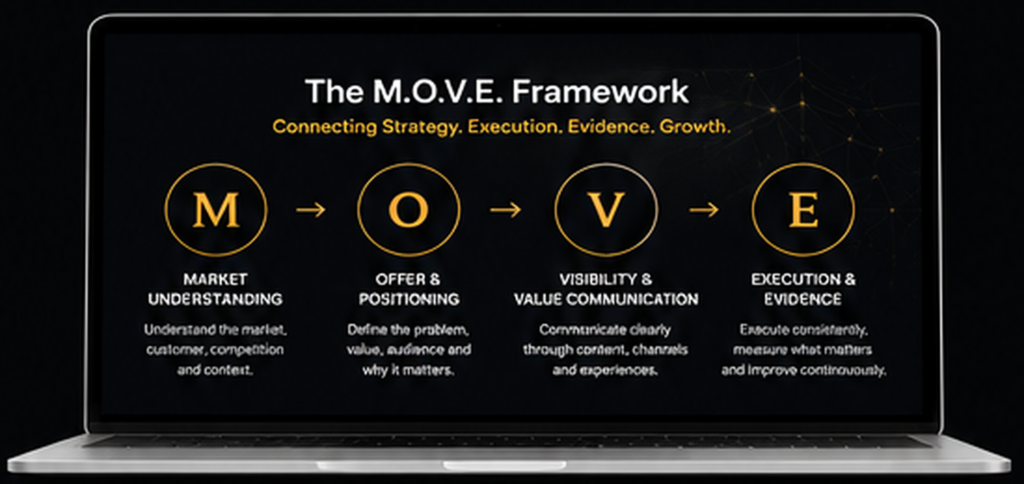
Developed the M.O.V.E. framework to help teams connect market understanding, positioning, visibility, execution, and measurement—creating a clearer path from marketing activity to predictable business growth.
Marketing teams often execute campaigns, create content, adopt tools, and report activity without a shared structure connecting those efforts to business movement.
I developed the M.O.V.E. framework to provide a practical system for understanding the market, strengthening the offer, creating meaningful visibility, and connecting execution with measurable evidence.
The goal was to help marketers and business leaders move from fragmented activity to aligned, accountable, and outcome-focused marketing.
THE CHALLENGE
Marketing activity was often disconnected from business priorities
Teams lacked a shared structure for strategic decision-making
Positioning and messaging were not consistently aligned
Execution focused on volume rather than meaningful outcomes
Reporting showed activity without clearly proving movement
THE OPPORTUNITY
Create a practical marketing framework that helps teams connect strategy, positioning, communication, execution, and evidence making marketing easier to understand, implement, evaluate, and improve.
STRATEGY & APPROACH
01
Understand
Identified the recurring strategic and execution gaps that prevent marketing teams from creating meaningful business movement.
02
Structure
Organized the marketing process into four connected pillars covering market insight, positioning, visibility, execution, and evidence.
03
Simplify
Translated complex marketing concepts into a practical framework that teams and leaders could understand and apply.
04
Apply
Connected the framework to campaigns, content, customer journeys, marketing operations, leadership, and revenue alignment.
05
Improve
Refined the model through practical application, feedback, evolving tools, and modern marketing requirements.
Execution Highlights
Market Understanding
Created a structured approach for examining customers, competitors, category conditions, market signals, and business context before execution begins.
Offer & Positioning
Developed a method for connecting customer problems, value propositions, differentiation, proof, messaging, and market relevance.
Visibility, Execution & Evidence
Connected communication, campaigns, customer journeys, operations, measurement, learning, and optimization into one continuous marketing system.
WHAT CHANGED
M — Market Understanding
Understand the customer, category, competition, context, and market conditions before deciding what marketing should do.
O — Offer & Positioning
Define the problem being solved, the value being delivered, the audience being served, and why the offer deserves attention.
V — Visibility & Value Communication
Communicate the offer clearly through relevant content, channels, campaigns, experiences, and trusted market presence.
E — Execution & Evidence
Turn strategy into coordinated action, measure meaningful progress, and use evidence to improve future decisions.
My Role In The Transformation
Identified the need for a connected marketing operating model
Created and structured the four M.O.V.E. pillars
Defined the purpose and principles behind each stage
Connected strategy with execution and measurement
Developed practical applications, tools, and exercises
Integrated the framework into leadership and growth thinking
WHAT CHANGED
Market Understanding
The framework gave teams a structured way to move from market understanding to focused execution.
Stronger Strategic Alignment
Marketing decisions could be connected more clearly to customer needs, positioning, and business priorities.
More Connected Execution
Content, campaigns, channels, operations, and measurement became parts of one coordinated system.
Better Evidence of Progress
Teams gained a clearer way to assess whether marketing was creating meaningful movement rather than simply completing activities.
Strategic Takeaway
“Marketing should not just exist. Marketing should M.O.V.E.”
The framework reinforces a central principle: marketing becomes more valuable when market insight, positioning, visibility, execution, and evidence operate as one connected system.